


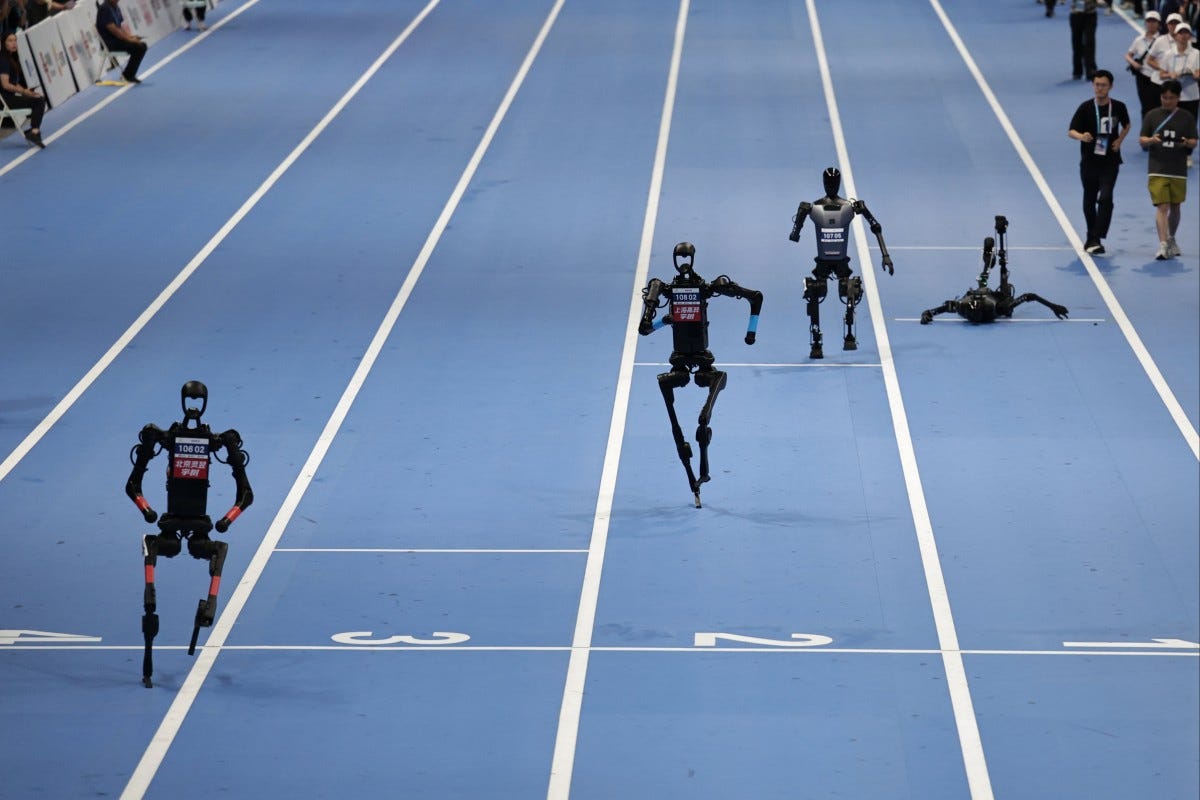
In April 2025, twenty-one humanoid robots lined up beside human runners in Beijing’s Yizhuang district for what organizers billed as the world’s first humanoid half marathon.1 Most didn’t finish. Several fell over at the start. The coverage abroad ranged from hyperbolic to dismissive: evidence of Chinese technological mastery or a performative spectacle designed to impress the world.
China’s technology landscape is indeed layered with infrastructures and buildings built primarily to be seen: exhibition halls, demonstration zones, nighttime drone shows, smart-city command centers with wall-sized screens. Chinese has a term for the tendency, 面子工程 (mianzi gongcheng), “face engineering,” and in 2025 Xi Jinping himself criticized wasteful vanity projects.2 But to stop there misses what these projects do. A robot race on a closed urban course is also a test: of locomotion over real pavement, of battery endurance, of how machines behave among crowds. Yizhuang, not coincidentally, is also where Beijing’s autonomous vehicle testing zone has spent five years accumulating edge cases on public roads.
Chinese policymakers have a word for what connects these things, and it has become one of the most important concepts in the country’s industrial policy for artificial intelligence: 场景, changjing, or “scenario.”
What is a scenario?
In Chinese policy vocabulary, a scenario is a bounded, real-world environment in which an emerging technology can be deployed, observed, and improved before it is commercially viable. “Scenario innovation” (场景创新) and “scenario opening” (场景开放) entered official usage in the late 2010s, and in July 2022 six central agencies, led by the Ministry of Science and Technology and including the Ministry of Industry and Information Technology, issued the Guiding Opinions on Accelerating Scenario Innovation to Promote High-Quality Economic Development through High-Level AI Application.3
The document defines scenario innovation as a process oriented toward the creative application of new technologies, proceeding by linking supply and demand, through which new technologies are iteratively upgraded and industries grow. Note the emphasis. Not deployment for its own sake, but iteration: the technology gets better by being used in the real world.
The document’s most revealing line comes in its section on scenario lists, which instructs localities to publish scenario opportunities regularly so that AI cultivation shifts from “giving policies” and “giving projects” to “giving opportunities” (从”给政策”“给项目”到”给机会”). Subsidies and policy documents were the first generation. Building projects was the second. The third is supplying the conditions under which firms can learn.
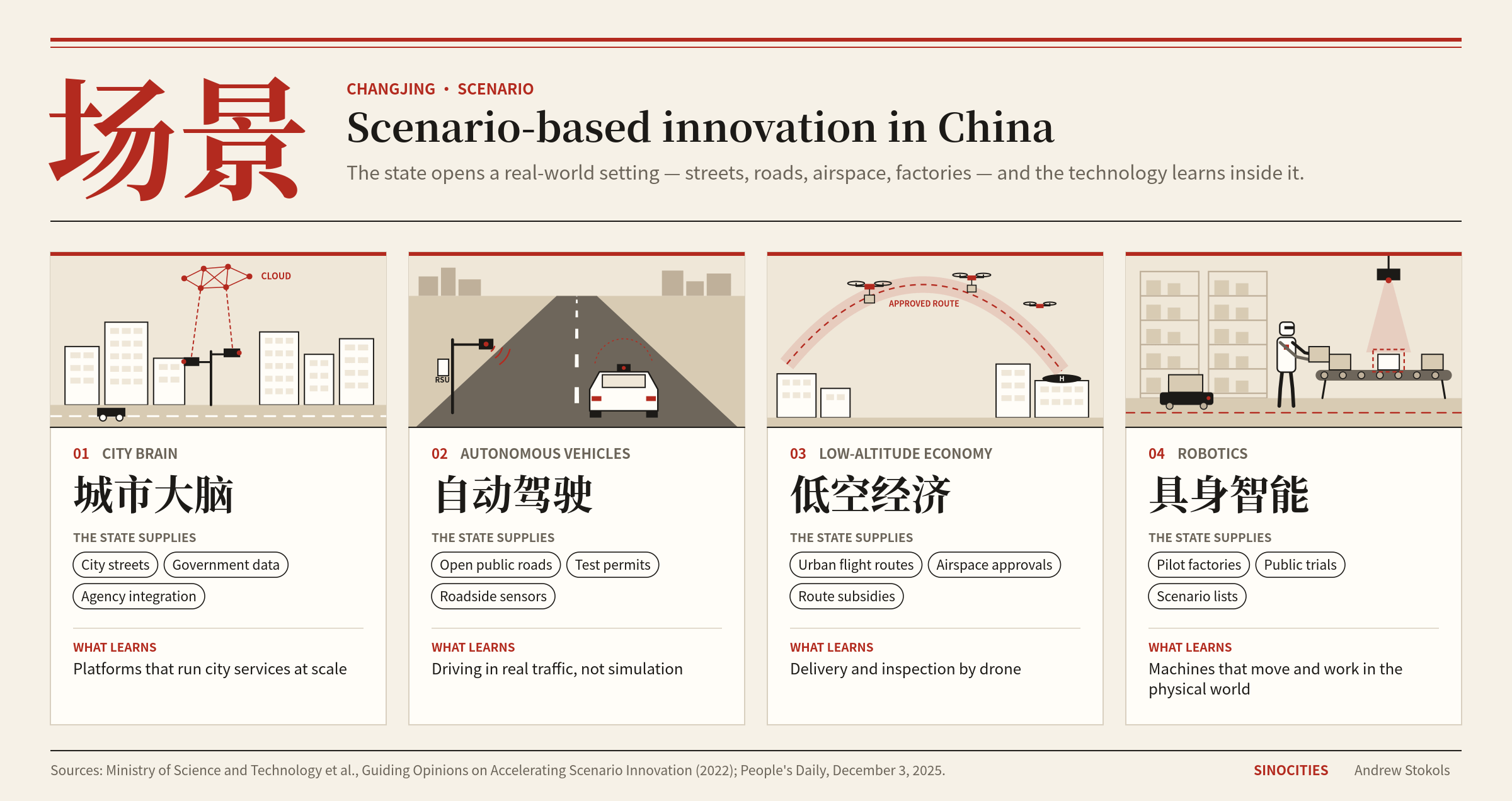
The document then lists priority scenarios: city brains and urban IoT sensing, autonomous driving and smart roads, unmanned delivery, machine-vision inspection in factories. Each is an officially sanctioned use case, a problem the state wants solved, paired with the physical and administrative access needed to try solving it.
Scenarios in practice
The Hangzhou City Brain, launched in 2016, was among other things a scenario: a traffic problem addressed by marshaling AI-enabled cameras, Alibaba’s cloud platform, and integration with the city’s traffic police. Once the platform existed, the city kept opening new scenarios on top of it: automated parking, linked hospital information systems, online utility payments. And in early 2020, the most consequential scenario of all: the health code (健康码) rehearsed in Hangzhou and then expanded as a draconian but momentarily effective form of Covid-19 prevention to the entire country within weeks.
For private companies like Alibaba, the direct monetary value of smart city/ or city brain contracts was not high. In recent years, Ali Cloud laid off most of its staff working on smart city projects and largely exited this area. Yet for private companies, access to the scenario held deeper value: real departments, real intersections, real data flows, and the reference value of being the birthplace of the city brain. In scenario economics, provision substitutes for procurement.
A similar logic can be seen in other cases I’ve studied. Beijing’s Yizhuang high-level AV pilot zone and Wuhan’s open road network gave autonomous vehicle firms years of testing on public streets under legal and political protection, supplying what no simulator can: complicated real-world environments with delivery tricycles, unpredictable pedestrians for algorithms to be trained on. Shenzhen’s designated drone flight corridors turn segments of urban airspace into scenarios for “low altitude” networks that are still far away from full commercialization. And Xiong’an, the new city under construction south of Beijing, extends the logic to an entire urban area, with sensors installed as the city is built and construction approval routed through a digital city model.
The scenario is defined additively: by what the state supplies. This can include specific terrain, state procurement as a form of guaranteed demand for products, data access, often bundled together and opened to firms.
A scenario is not a regulatory sandbox
The closest Western analogue is the regulatory sandbox, but there are immediate differences from the contemporary Chinese use of “scenarios.”
The concept originated with the UK’s Financial Conduct Authority, which proposed a sandbox for fintech in November 2015 and opened it to applicants in May 2016. The FCA described it as a “safe space” in which businesses could test innovative products and business models without immediately incurring all the normal regulatory consequences of the activity.4 Its tools were entirely legal: restricted authorisation, individual guidance, waivers, and no-enforcement-action letters. The European Union’s AI Act, which required every member state to have an AI regulatory sandbox running by August 2026, defines one as a controlled framework set up by a competent authority, offering AI providers the chance to test systems for a limited time under regulatory supervision.3 The sandbox, in other words, is defined by what the state withholds. It is permission: an agreement not to enforce certain rules within a bounded space. In this sense it echoes the special economic zone, which China has used with some success particularly in places like Shenzhen.
The scenario, meanwhile, is defined additively: by what the state supplies. This can include specific terrain, state procurement as a form of guaranteed demand for products, data access, often bundled together and opened to firms. A Chinese scenario might combine a designated stretch of road or airspace, data drawn from several ministries or jurisdictions, a municipal government willing to be the first customer, and the political support of an official demonstration designation.
A 2025 Renmin Ribao article explains the value of scenarios as “The innovative value of scenarios also lies in their integrative effect, like grains of sand accumulating into a tower. Translating innovation outcomes into practice requires the "hard support" of infrastructure and platforms, and also the backing of a "soft environment" of laws, institutions, and policies.”5
This difference explains the difference in scale. Permission is politically cheap to grant, and so it is kept small, bounded, and temporary. Provision runs through the full machinery of the Chinese local state: land allocation, state-owned builders, municipal investment vehicles, and officials whose promotion prospects depend on visible, countable achievements. That machinery builds at scale, which is why a European AI sandbox hosts a dozen systems while a Chinese city can open its entire traffic network.
The scenario, meanwhile, is defined additively: by what the state supplies. This can include specific terrain, state procurement as a form of guaranteed demand for products, data access, often bundled together and opened to firms.
Nor is it policy experimentation…
Scenarios also differ from pilot zones, which have been familiar to observers and scholars of China’s political economy. The policy experimentation described by Sebastian Heilmann, in which the Chinese state trials new rules in pilot zones before extending them nationwide.6 Special economic zones, rural land reform pilots, and local healthcare experiments all follow this pattern. In policy experimentation, the state tests rules on populations, and the learning then informs future policies that may scale or may not. For scenario-based innovation, the state opens bundled infrastructural layers ( urban space, data, physical systems ) so that technologies can be trained and scaled. Firms do not retain control over these infrastructural substrates but they can and do accumulate knowledge and training data.
Everett Rogers’ classic work on the diffusion of innovations identified observability and trialability as key conditions for new technologies to spread.7 The demonstration zone provides observability: it lets officials, investors, and the public see a technology working. The scenario provides trialability: it lets firms actually deploy technology in the real world.


Why scenarios matter even when projects fail
This is where the face-engineering critique needs some adjustment. By conventional measures, many Chinese showcase projects are wasteful. But showcase projects also do things that conventional measures don’t capture. They send a signal of support to emerging industries. They build local capacity. They help develop technical standards that can then be refined through iterative processes. They demonstrate the viability of new technologies in distant parts of the country. They create durable relationships between firms and government bureaus. And they commit capital that constrains subsequent decisions.
The scenario concept sharpens this process. If a project is judged as an asset, then an underused facility is mostly wasteful. If it is judged as a scenario, the question becomes what was learned inside it. An empty data center is a stranded asset. An underused vehicle-infrastructure corridor that generated years of operational data, trained engineers, and produced industry standards does actually matter for the accumulation of technical capacity and institutional knowledge.
China’s autonomous vehicle program is the clearest example. The government’s preferred architecture, 车路云一体化 che lu yun yitihua vehicle-road-cloud integration, preferred to build out entire intersections with roadside sensors and edge computing on the theory that cars able to draw on smart infrastructure to see would be more safe and secure than fully infrastructure independent vehicles. Industry practitioners now widely regard that hardware as redundant: the leading AV firms like Waymo and China’s own Apollo (Baidu) vehicles navigate primarily with their own onboard sensors. Companies don’t wish to sell self-driving cars that only work safely if they connect to intelligent intersections. Yet deployment continues, because what the firms were consuming was never really the hardware. It was the scenario: the protected deployment environment, the permits, the edge cases, the municipal partners with a stake in success. While the technical architecture proved mostly unnecessary, the firms still managed to walk away with valuable learning and training data. Scenario innovation can generate genuine technological progress. It can also generate a great deal of expensive hardware whose main function is to serve as evidence of a particular local officials’ accomplishments so they can be promoted.
If scenarios are how China’s system helps technologies learn, then it should help some technologies far more than others. DeepSeek emerged from a Hangzhou quantitative hedge fund, not from a state-sponsored AI demonstration zone. But technologies that must perceive, navigate, and act in physical space have different requirements. Autonomous vehicles, drones, industrial robots, and the emerging category China calls 具身智能 (jushen zhineng), “embodied intelligence,” depend on real-world iteration that simulation can only partly replace. For these, a system that manufactures deployment environments at scale is a genuine advantage.
Some of the robot races, the humanoid pilot parks, the embodied-AI scenario lists now appearing in city after city are certainly forms of “face engineering.” But it is also the strategy of scenario-based innovation. Whether that produces world-leading robots or warehouses of useless idle humanoids is an open question. Thus, a critical question to be asking about Chinese AI is not only who has the better models, but who has the better environments and complex scenarios in which machines and models learn.
https://www.reuters.com/world/china/china-pits-humanoid-robots-against-humans-half-marathon-2025-04-19/
https://www.foreignaffairs.com/china/chinas-edifice-complex
关于加快场景创新以人工智能高水平应用促进经济高质量发展的指导意见》(Guiding Opinions on Accelerating Scenario Innovation to Promote High-Quality Economic Development through High-Level AI Application), 国科发规〔2022〕199号, dated July 29, 2022; https://www.gov.cn/zhengce/zhengceku/2022-08/12/content_5705154.htm.
Financial Conduct Authority, “Financial Conduct Authority’s Regulatory Sandbox Opens to Applications,” press release, May 9, 2016, https://www.fca.org.uk/news/press-releases/financial-conduct-authority%E2%80%99s-regulatory-sandbox-opens-applications.
Liu Wenxin 刘温馨, "'Changjing' weihe neng chengwei guanjian chuangxin ziyuan?" "场景"为何能成为关键创新资源? [Why has the "scenario" become a key innovation resource?], Renmin ribao 人民日报, December 3, 2025, 1.
Sebastian Heilmann, “Experimentation under Hierarchy: Policy Experiments in the Reorganization of China’s State Sector, 1978-2008,” Center for International Development Working Paper 172 (2008): 21.
Rogers, Everett M. Diffusion of Innovations, 5th Edition. Simon and Schuster, 2003.