


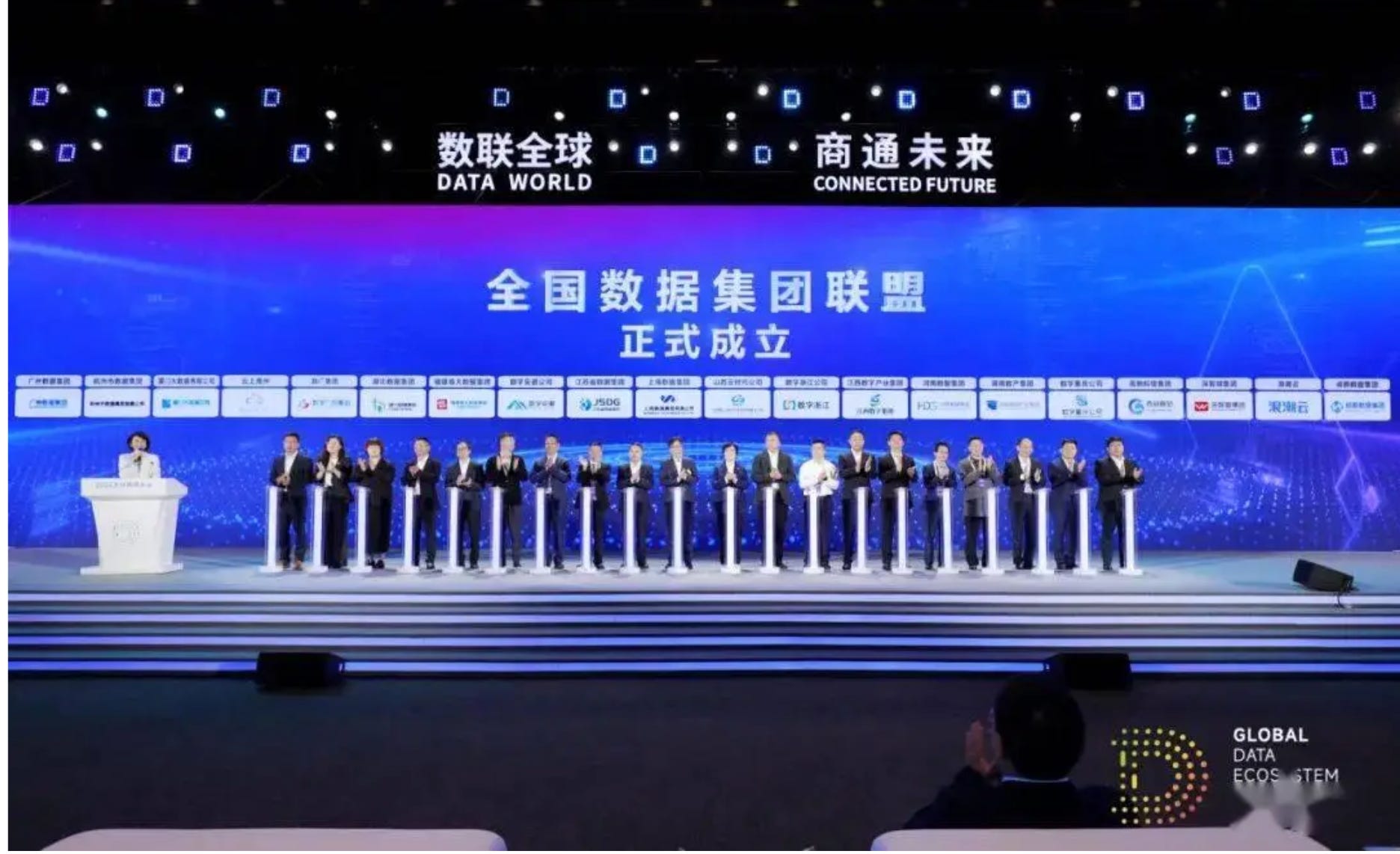
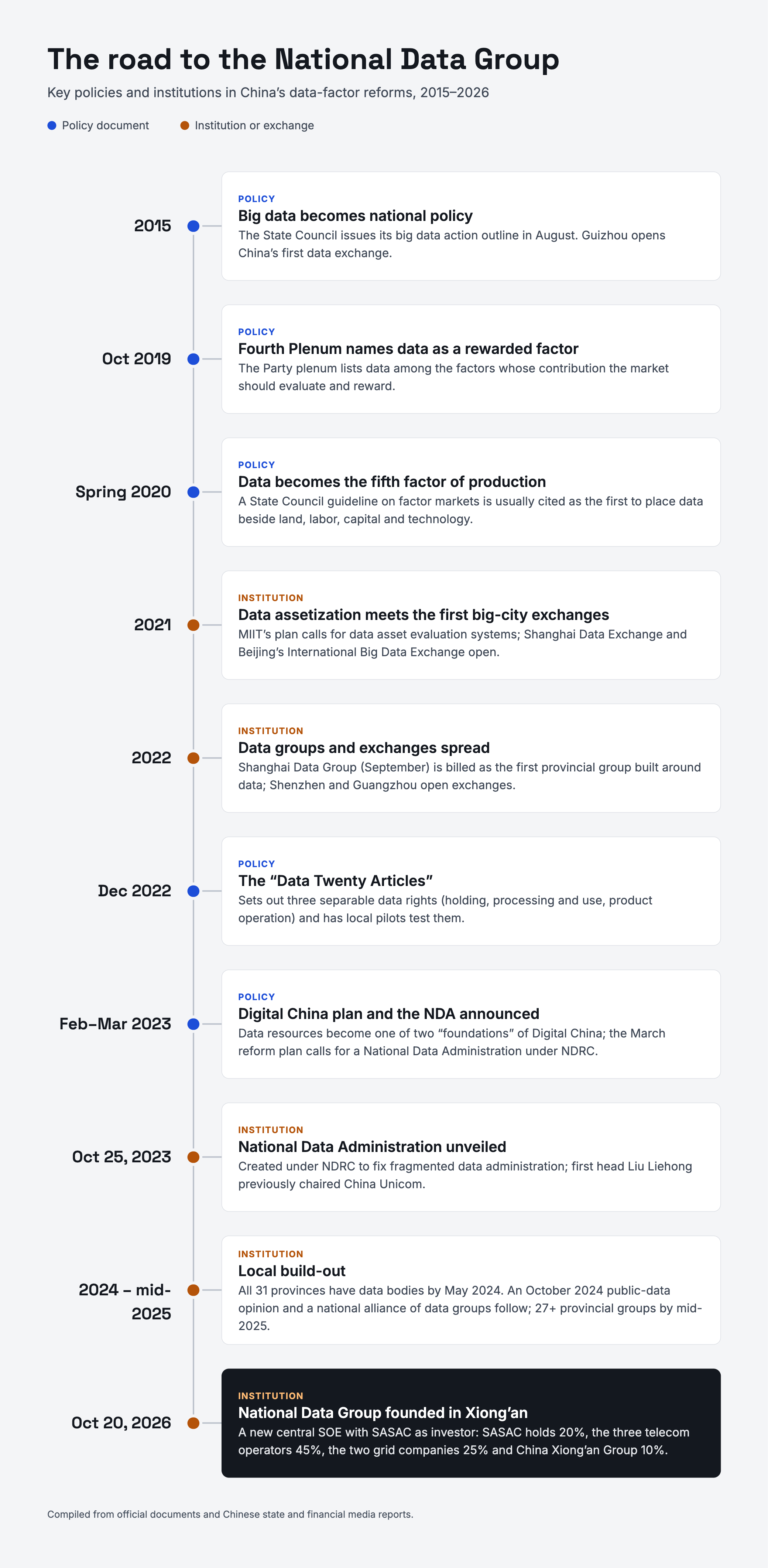
China recently set up a new central state owned enterprise—the “National Data Group” or 国家数据集团 October 20, 2026.1The company, like many new SOEs created recently, will be headquartered in Xiong’an New Area, the new city outside of Beijing personally championed by Xi Jinping. The founding of the National Data Group did not happen in a vacuum. It is the latest push in a longstanding effort by the Party-state to unleash China’s massive amounts of data, much of it in state hands, for broader economic benefit. The founding of a national data SOE is an effort to consolidate the fragmented array of local data exchanges and provincial data groups, which have been seen by some as ineffective at promoting broader use of public data. It comes three years after the founding of the National Data Bureau under the NDRC—so the SOE can be seen as the market implementation entity, while the bureau sets policy. The personnel overlap is notable: the group’s chairman, Jian Qin, was previously general manager of China Unicom, and its general manager, Chen Ronghui, was a deputy head of the bureau and, before that, ran Fujian’s provincial data group. The bureau’s first head, Liu Liehong, also came from China Unicom.2 China’s three telecom operators (China Telecom, China Mobile, China Unicom) each have a 15% stake in the new group, along with State Grid and Southern Grid 12.5% each, and China Xiong’an Group 10%. The State Council’s asset regulator, SASAC, itself holds the largest single stake, 20%, in the group’s RMB 30 billion of registered capital.3 This gives some clues to the positioning of the new group in relation to the data-rich energy and telecom sectors.
The official duties of the new group will include: 4
数据要素服务国家队 (national team for data-factor services). The Xinhua feature on Xiong’an’s official site says the group will offer inclusive, secure data services and industry data governance services, and that this supports the “AI+” campaign.
数据基础设施互联互通引领者 (leader in data-infrastructure interconnection). The same piece names this as the second pillar.
国家数据科技创新战略力量 (strategic force for national data technology innovation). It ties this third pillar to supplying high-quality datasets and corpora to the AI industry.
Policies on Data
The 2020 guideline on market-based factor allocation is usually cited as the first to treat data as a fifth factor beside land, labor, capital, and technology, following a resolution at the fourth plenum in 2019 and various speeches by Xi Jinping promoting the idea. In 2020, China’s State-owned Assets Supervision and Administration Commission (SASAC) issued a notice calling for state-owned enterprises to begin valuing data assets.5 In Nov 2021, the Ministry of Industry and Information Technology (MIIT) released the 14th Five Year Plan for Big Industry Development to “develop market operation systems for data asset evaluation,” and “promote industry data assetization (数据资产化shuju zichanhua) and productization” (MIIT, 2021). The “20 articles on data” released in 2022 established the “separation of three rights”: the right to hold data resources, the right to process and use data, and the right to operate data products” and encouraged local governments to create local data exchange pilots.” 6
The outline of the 15th Five Year Plan then called for building a nationally integrated data market that is open, shared and secure (Zhu, 2026). However, private firms have not eagerly embraced exchanges, lacking proper incentives, and afraid of attracting undue regulatory scrutiny or giving away trade secrets. There is also a fundamental tension between the goal of increasing “data flow” shuju liutong, and valuing data into an asset. A Beijing-based professor of digital governance reflected to me, “People are talking about data as a tradeable asset, that but if data becomes a tradeable asset, then how can it be utilized properly in other functions? This is a conundrum.”7
Data exchanges
Data exchanges were a policy experiment to set up dedicated government entities in cities across China to manage the use and exchange of public and private data. The thinking was that if data were to be fully utilized as a “factor of production,” then there would need to be dedicated government entities to manage this process. The first data exchange was actually set up in Guizhou in 2015. A manager of Guizhou’s Data Exchange had predicted 10 bn Yuan in trading volume but by 2019 the exchange had only managed about 5 Mn in annual transactions (Mu, 2021). Recently, many of the Guiyang officials were purged in a corruption crackdown, with the head of the Guiyang Data Bureau being accused of using state-owned data centers for illegal cryptocurrency mining. Beijing set up an International Big Data Exchange in 2021 and The Shenzhen and Guangzhou Data Exchanges opened in 2022. The Shanghai Data Exchange was launched in 2021, and in 2024 Shanghai launched the Data Asset Market on June 28, 2024, which has apparently listed 2,700 datasets and had a transaction volume of 1.16 bn Yuan in 2023. Shanghai’s released thorough and fairly extensive guidelines on how to value data as an asset, working with auditors and other financial professionals to develop standards for data valuation and trading. Still, the volume of actual data on these exchanges has remained paltry, hampered by a fact that firms have no real benefit from listing data on exchanges compared to simply pursuing data transactions on their own with other companies.8 However, some SOEs including banks and telecoms, have participated in a limited degree in listing their data on these exchanges.
As an executive at a Shanghai-based data analytics firm told me, “Between two companies, we have a contract and can also do data transactions. So data transactions do not necessarily take place in data exchanges, but government data transactions usually come out through exchanges. So the data market is more for the public sector. Of course, companies can also use it, just like the stock market, but companies do not have to use it.”9
Data groups
The exchanges were only one part of a broader local build-out. The first dedicated data bureaus appeared in a handful of provinces and cities starting in 2014, and after the National Data Bureau was created in 2023 the rest followed: by May 2024 all 31 provinces and the Xinjiang Corps had set up a data body, and most had also created a state-owned data group to handle the commercial side.10 Shanghai’s group, set up in 2022, was billed as the first provincial group built around data as its core business, and acts as the authorized operator of the city’s public and state-enterprise data. Beijing, Jiangsu, Sichuan, Hubei, Shaanxi, Hunan, Henan and Fujian now have their own, and Zhejiang and Shandong launched groups this past August.11 The general manager of Qingdao’s data group has likened its role to the “primary developer” (一级开发商) in land markets: preparing a raw resource so that others can build on it.12
A count published in mid-2025 found at least 27 provinces and autonomous regions with a provincial data group, which it sorted into three rough types: operators of authorized public data, mostly formed in the two years before the count; government-informatization platforms, mostly built in 2018–19; and “multi-role” groups that assemble data, run trading platforms and write trading rules, the largest category.13 Fujian’s, the largest by registered capital at RMB 10 billion, belongs to the last type and is the one Chen Ronghui ran. Financing results from data assets were still modest: Fujian, Guangxi and Henan had each secured credit of RMB 8–10 million backed by data assets or data products. A national alliance of data groups was formed in October 2024, and reports that a national group was being prepared surfaced in early 2025, well before its launch.
Chinese commentators present the national group as a fix for the limits of this piecemeal approach. Li Jin of the China Enterprise Research Institute told Yicai that earlier data reforms were scattered experiments in which confirming rights, pricing, trading and sharing revenue all proved difficult, and that a state-led entity could impose uniform standards, rules and procedures (Zhu, 2026). The same account points to a “paradox” in which demands for openness and sharing collide with security limits and persistent silos, and describes data as a trillion-yuan emerging industry. Zhang Xianghong of the National Data Expert Advisory Committee frames the division of labor as the bureau handling institutions and policy design while the group handles market operation. Li also expects Fujian’s experience to carry over, since Chen Ronghui previously ran the province’s data group. What remains unclear is the relationship to the local groups. Official statements speak of “central–local linkage” and shared capabilities, but nothing announced so far says that provincial groups will be folded into the new company.14
Xiong’an as testbed

Xiong’an’s role goes beyond being a place to move a headquarters. Official coverage stresses that the new area was planned as three cities built in parallel: above ground, underground and in the cloud. It points to the Xiong’an City Computing Center, said to hold over 40 billion records, and nearly 10,000 smart sensing devices of some twenty types installed in Rongdong utility tunnels, mounted on roadside units, all wired into a digital urban management system. Xiong’an was also chosen in all three categories (city, industry and enterprise) of the National Data Bureau’s 2025 trusted data space pilots, and SASAC says that locating the headquarters there is meant to draw high-end industries in around a leading firm.15 This is promotional language, but it shows how the group’s location is being tied to Xiong’an’s showcase digital infrastructure.
Xiong'an: the City as Showroom

Urban exhibition halls, complete with large models of city buildings are a common feature in nearly every major city in China. But with Xiong’an, the entire city has become a kind of showroom.
https://www.cndg.com/home
On the appointments of Jian Qin and Chen Ronghui, see China Economic Net, October 20, 2026 (http://www.ce.cn/xwzx/gnsz/gdxw/202610/t20261020_3265656.shtml). On Liu Liehong, formerly chairman of China Unicom, see The Paper, March 28, 2026 (https://www.thepaper.cn/newsDetail_forward_32848044). Chen’s earlier role at Fujian Big Data Group is from Li Jin, quoted in Zhu (2026).
Shareholding and registered capital figures come from corporate registry data as reported in Chinese media, e.g. C114 via Sina Technology, October 26, 2026 (https://finance.sina.com.cn/tech/roll/2026-10-26/doc-iniwqhxk2384080.shtml).
https://www.sohu.com/a/1090787167_115571
SASAC is an agency that manages most of China’s state-owned enterprises (SOE)
CPC Central Committee and State Council. 2022. “Opinions on Establishing Basic Data Systems to Better Play the Role of Data Elements” (关于构建数据基础制度更好发挥数据要素作用的意见). December 2022.
Interview, Professor of Public Policy, Beijing (2024)
Arcesati R and Groenewegen-Lau J (2023) China’s data management: Putting the party-state in charge. Merics.
Interview, data company (Shanghai, 2024)
Liu Liehong, head of the National Data Bureau, at a State Council Information Office press conference on May 10, 2024, as reported by Yicai (https://www.yicai.com/news/102104664.html).
The list of provincial groups is from Zhu (2026). On Zhejiang and Shandong, see Beijing News, October 21, 2026 (https://www.bjnews.com.cn/detail/1792577745129341.html). On Shanghai Data Group, see Shanghai SASAC, October 2023 (https://www.gzw.sh.gov.cn/shgzw_zxzx_gqdt/20231012/f5f55353e13c474fbed6c86168c9645e.html).
China Business Journal, February 2025, via Tencent News (https://news.qq.com/rain/a/20250222A00UDQ00).
Southern Finance (21st Century Business Herald), June 19, 2025, via Sina Technology (https://finance.sina.com.cn/tech/roll/2025-06-19/doc-infarhcm3680001.shtml).
See Xinhua, October 20, 2026, via the National Data Administration website (https://www.nda.gov.cn/sjj/swdt/mtsy/1020/20261020191823470535612_pc.html), and Beijing News, October 21, 2026, which notes that public information has not specified a division of labor between the national and local groups.
Zhu, Y. (2026, October 21). New central SOE “National Data Group” established: Which long-standing problems will it tackle? [新央企国家数据集团成Yicai (China Business Network). Retrieved October 26, 2026, from https://mp.weixin.qq.com/s/NIHsXDvsYn7oPrx1Onuy5Q