


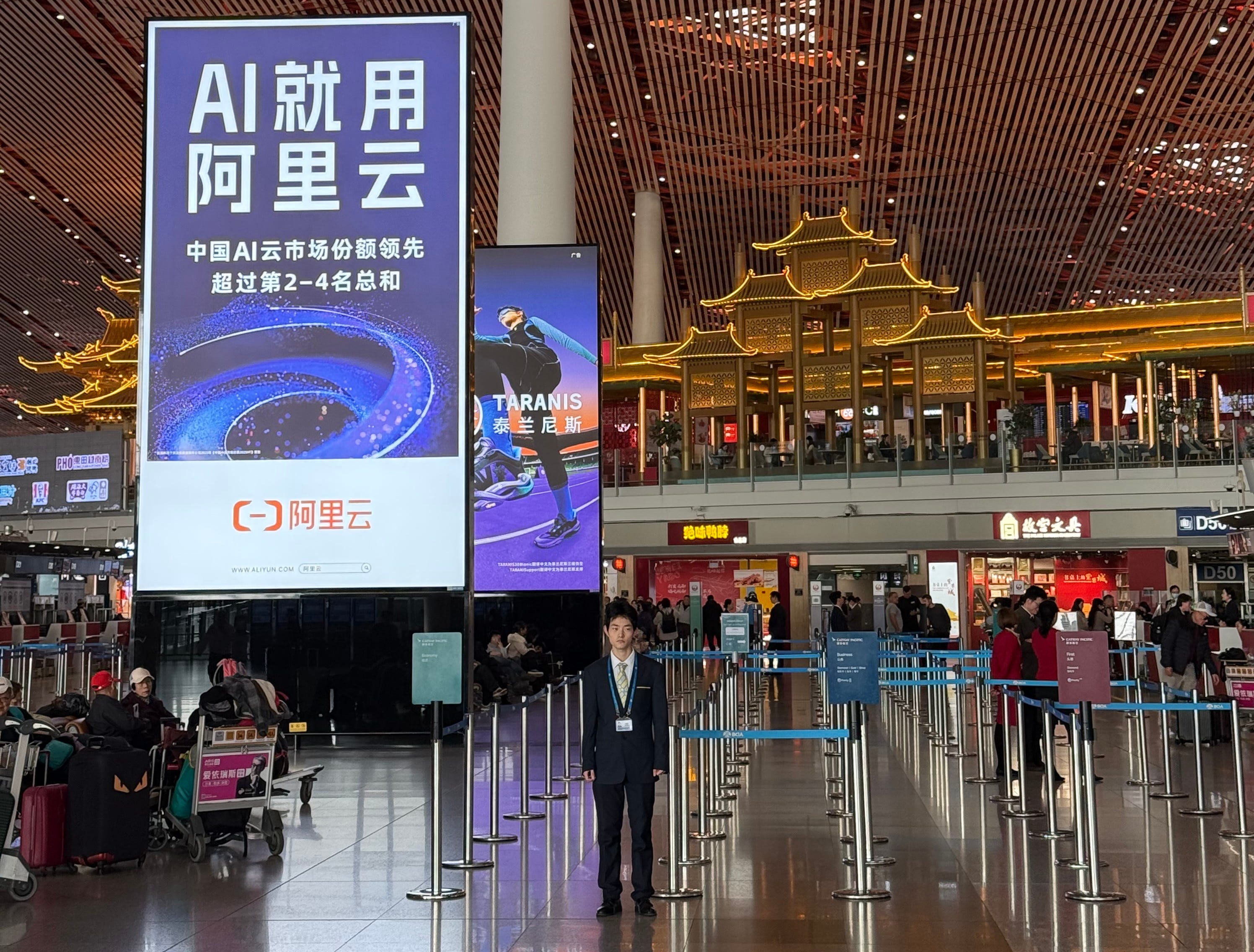
I landed in Beijing’s capital airport on a cold evening in October. Inside T3, which was completed just in time for the 2008 Beijing Olympics, bright towering illuminated advertisements from Huawei, Ali Cloud, Bytedance, and other leading tech firms greeted passengers as we got off the plane—totems to the age of AI. China and the U.S. are leading players in this global race (some would say bubble) toward “artificial general intelligence,” or at least what we perceive to be artificial intelligence. This trip in China was characterized by visits of some of China’s leading technology coupled alongside a persistent pessimism toward the overall economy and livelihoods for everyday citizens.
In Shanghai, I visited an exhibition of consumer-driven AI technologies at the West Bund, a new district south of the city center home to leading tech companies including Alibaba 阿里巴巴, Sensetime 商汤科技, and Tencent 腾讯, as well as new museums like West Bund and Long Museum. Inside the exhibition hall, I was greeted by a smattering of robots, some of them cute and furry, others more utilitarian. A robotic coffee machine processed a picture of my face and printed it on the top of a latte, all for 20 Yuan ($2.80). A robotic ping-pong arm rallied with a girl as she returned each serve. Another small tabletop robot produced by Sensetime played the Chinese game of go with an older woman locked in concentration. Nearby, a humanoid robot from Unitree 宇树 danced and gyrated. Meanwhile, a man surreptitiously operated a soccer-playing robot as the crowd watched from the other side, assuming it was kicking a soccer ball of its own volition. The sheer variety of products and technologies on display are evidence of the enormous creativity and experimentation going on in China’s tech space, and one where “AI” features and physical products are increasingly intertwined.
“Since the advent of ChatGPT, there have been growing reports of people using AI chatbots for psychological counselling or cures for loneliness. In China, this has taken a cuter and more physical form”
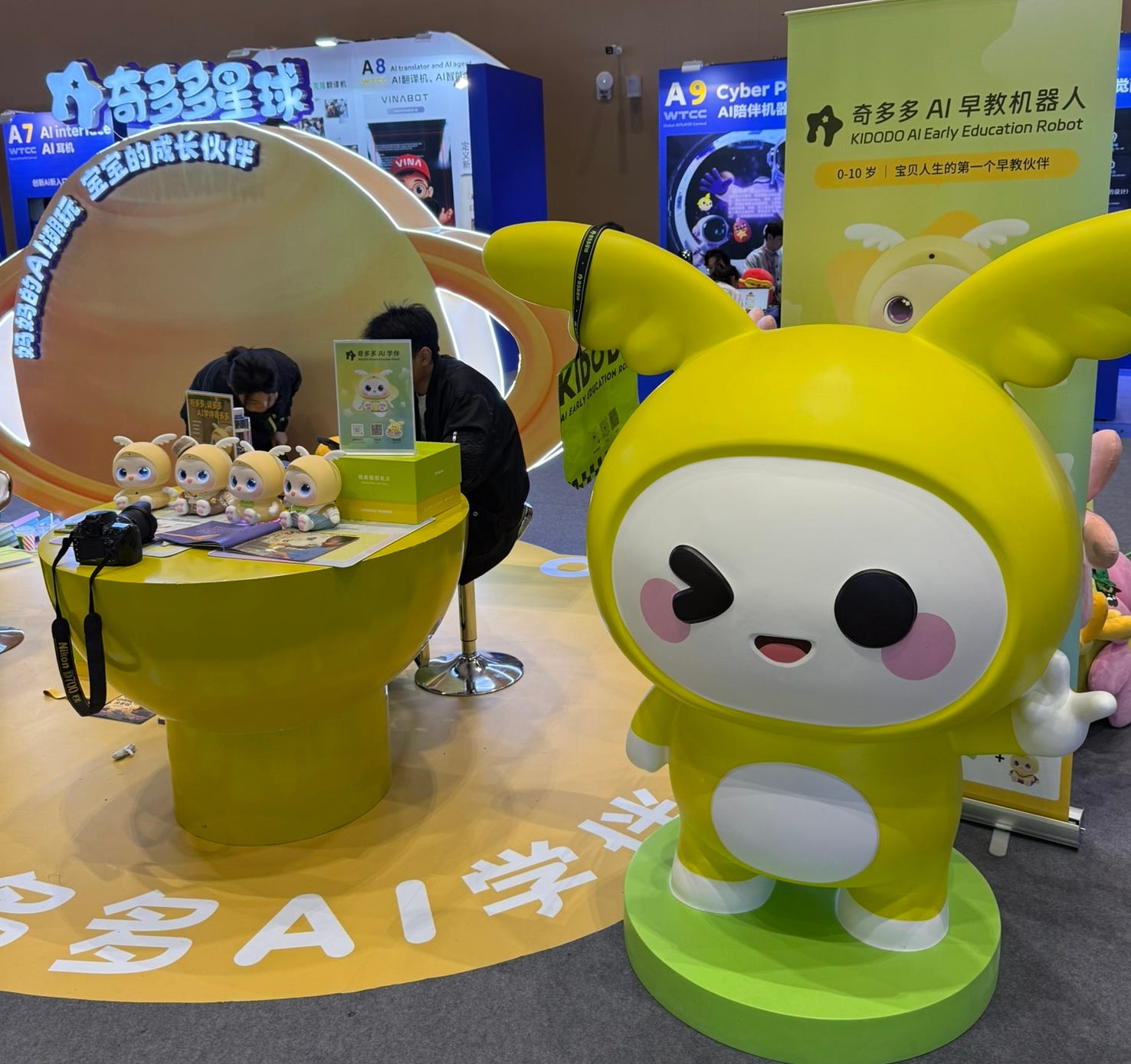
Another category of products on display were what I would describe as “cute companion tech”, dolls or plushies equipped with intelligent conversational abilities to offer comforting words of solace for overworked niuma 牛马1 after they return home from grueling hours in China’s 996 culture. A capybara plushie was advertised as an “AI companion,” although the device wasn’t working so I couldn’t get to test it, even as I toyed with the idea of buying it for my nephew. Many of the products on display promised some form of emotional companionship or mental health diagnosis. A pendant necklace equipped with sensors for body heat and other diagnostics was promising the world’s first emotional sensing AI necklace. Since the advent of ChatGPT, there have been growing reports of people using AI chatbots for psychological counselling or cures for loneliness. In China, this has taken a cuter and more physical form, with AI-powered companion devices or plushie animals equipped with AI-powered conversation ability, promising to cure loneliness or other mental ailments. An attendant showed me a humanoid robot that had soft muscle-like material that was more tactile and gave off heat, to better replicate human qualities compared to the rather spindly and somewhat creepy Unitree robot. The man at the display told me they were intended as companions for elderly or disabled.


Just as with Silicon Valley techno evangelists, the idea that more technology is the answer to the global loneliness epidemic, which has itself been fueled by social media and solipsistic tendencies of phone addicted youth, is alive and well in China’s AI age. Addressing the loneliness epidemic of modern life with more tech is like fighting poison with poison (以毒攻毒). Meanwhile, neither societies have good answers for the really hard questions—what should unemployed graduates should do with their lives, and deeper questions like what kind of life is worth living when work is no longer the main purpose of our existence? On the other hand, many of the products I saw are market responses to the reality of China’s ageing population. In a country long defined by filial piety, how do children make sure their elderly parents living far away are taken care of?
Many of the products on display were gimmicky, to say the least. A small humanoid robot kicking a soccer ball around a small pitch was being manipulated by an attendant, his fingers manipulating a hidden controller beneath the table to give the illusion of autonomous control. Another “cosmic AI companion” which was due to be released in a few months, would offer astrological advice and fortune telling. The cheery young attendant who approached me in clear English had just graduated from UC Berkeley and had returned to China to work in this small AI startup.
A smaller section of the exhibition floor in the rear featured industrial applications: an AI data platform that would optimize energy use for renewable power in large-scale industrial parks or factories was evidence of the integration of AI with China’s growing capacity in renewable energy and infrastructure. Nearby a woman dressed in an ethnic minority costume was standing by a booth from a small NGO advertising themselves in “rural education power by AI” which she told me could develop specialized teaching modules based on local needs in remote villages that lack adequate educational facilities. The idea was interesting but I didn’t quite understand how such a solution would be scaled or integrated into China’s vast rural areas, and the woman was scant on details of actual successful case studies or uses.
Despite some of the questionable products on display, the vast array of products was evidence that China’s AI sector is seeing a flurry of experimentation in AI-powered consumer tech. Whether or not these products are true examples of “AI” is another question. A friend of mine who is finishing a PhD in economics at Tsinghua tells me 绿色漂洗 luse piaoxi “green washing” is a popular topic in Chinese academic discourse recently, and surely we can add 数字漂洗 “digital washing” and 人工智能漂洗 “AI washing” to the mix. Companies promote themselves as being in AI to get funding and government subsidies. But China’s manufacturing prowess and its ability to quickly prototype physical products is a distinct advantage in its AI innovation ecosystem compared to the U.S. where LLM-powered chatbots have mostly been adopted by enterprises business services and for personal productivity.
As in the U.S, a lot of the money and innovation in China’s AI space is still flowing into a handful of leading technology companies. A friend who recently left a small startup to work on integrating AI solutions into Alibaba’s urban mobility applications, told me that they were trying to develop AI-powered transportation recommendations based on aggregating data from the hundreds of Chinese cities where passengers use Alipay to board subways or buses. Ali has access to a staggering amount of data on travel patterns in most large Chinese cities which, if utilized properly, could deliver customized travel suggestions or more efficient routing recommendations. Like the ride hailing app Didi or its global cousins Uber and Grab, Ali is poised to become an urban mobility company just because of its access to this data alone. But these solutions haven’t begun to generate profit for Ali yet, and the company is still investing in research and product development in order to find ways to monetize this data, using AI models as an accelerant.
Even as the AI race ignites a new wave of speculative investment, there is a sense that many other sectors are still struggling. A former colleague who works in Shanghai for one of the country’s leading real estate developers spoke of the still-dormant property market. The company she works for is trying to pivot to digital services in its existing properties since they are building fewer greenfield communities. While she had a decent position advising the company on digital solutions, she herself considers moving to one of China’s tech giants since they are the only ones expanding and seeing real growth these days. “A few years ago, a lot of people like me with overseas degrees in Shanghai would have worked for MNCs because they paid well, but many of them have left China.” Another Chinese friend who had studied in the U.S. and was working for a foreign environmental NGO in Beijing that is helping Chinese companies decarbonize was considering moving abroad, perhaps to Singapore, and said there were few similar non-Western organizations in China that paid a comparable salary for the kind of work he was doing.
Like in the U.S., the AI race/bubble is sucking investment and energy (both in kilowatts and zheng nengliang) out of other sectors and concentrating wealth and capital in a few leading firms. This is a commonality that is often lost in discussions of U.S. and China tech competition—AI promises wider benefits but seems to be concentrating wealth and resources even further, accelerating inequality and resentment in society that were already bubbling, both during China’s “Gilded age” boom years, and in the populist backlash toward the elites that has transformed American politics.
China’s government is aware of these risks and has pushed policies to make AI a tool for industrial development rather than a thing unto itself. There is a focus on application of AI to industry, production, and the 实体经济 shiti jingji “Real economy.” Under Xi, the government has taken a skeptical attitude to consumer internet and favored investment in “hard” industries like manufacturing, new materials, infrastructure. But this rhetoric is juxtaposed with market dynamics in which China’s leading tech players, with their existing advantages in data and software engineering talent, could be the ones to benefit most from AI, applying large language models to make their existing operations or services more efficient.
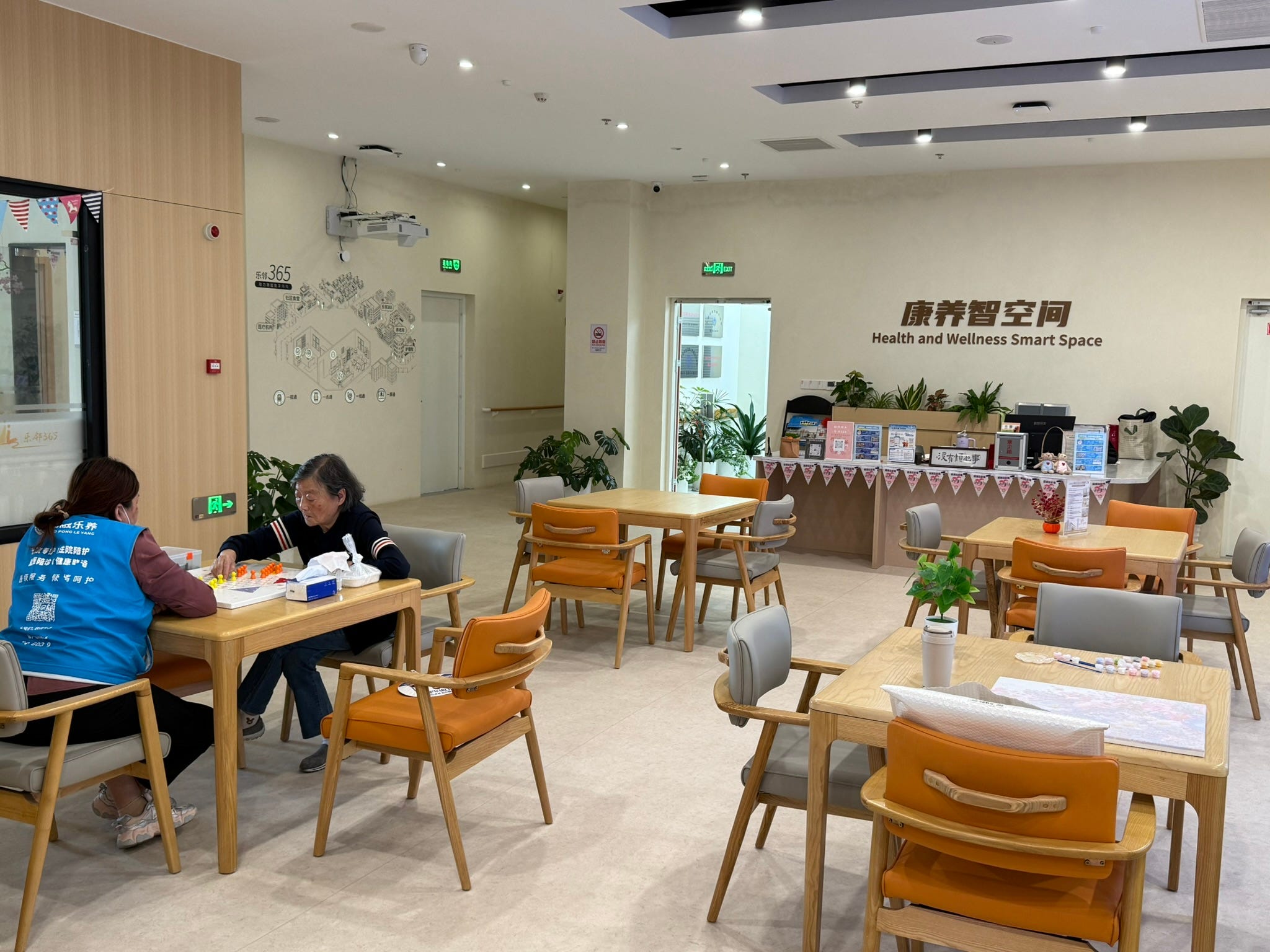
Despite this, there are other efforts to use AI and technology to address China’s ageing population and deeper social issues. In the Lujiazui area of Shanghai, not far from the glittering skyline that marked the city’s arrival as a global city, I visited a Community Center built by the district government. Shanghai has pioneered these community facilities, which often include a low-cost canteen with discounts available for elderly residents, party cadres, and veterans. Some of this policy began under the city’s previous Party Secretary Li Qiang, who was elevated to China’s #2 Premier following his faithful implementation of the Shanghai lockdown, which is a traumatic memory for many Shanghainese and those who lived through it. This center also had numerous facilities for intelligent healthcare and elderly services. There are various “smart products” on display: a smart couch that can move to help elderly get up, a smart bed. There are rooms one can book here to stay, and receive services like health checkups, treatments, and other activities.
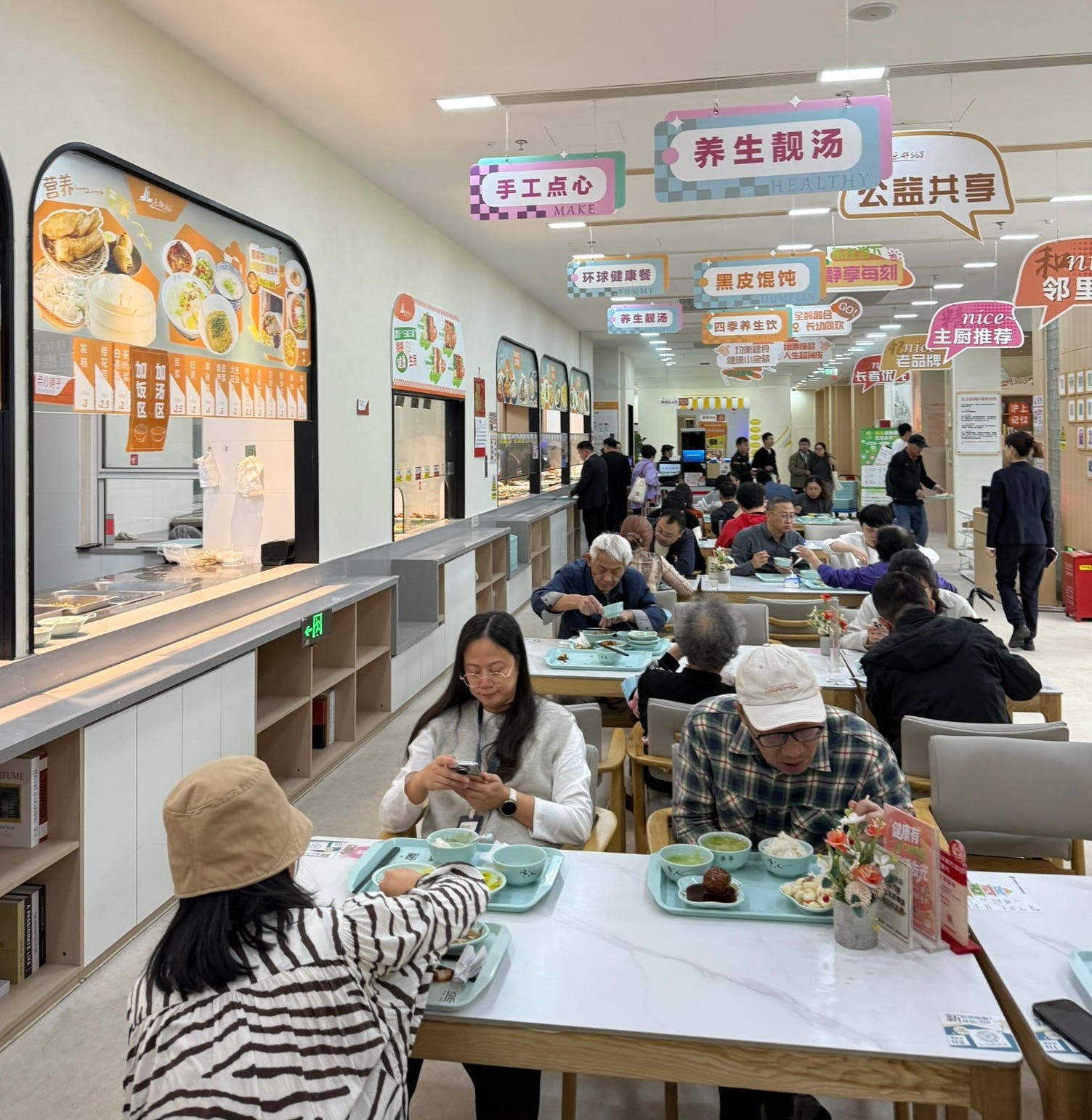
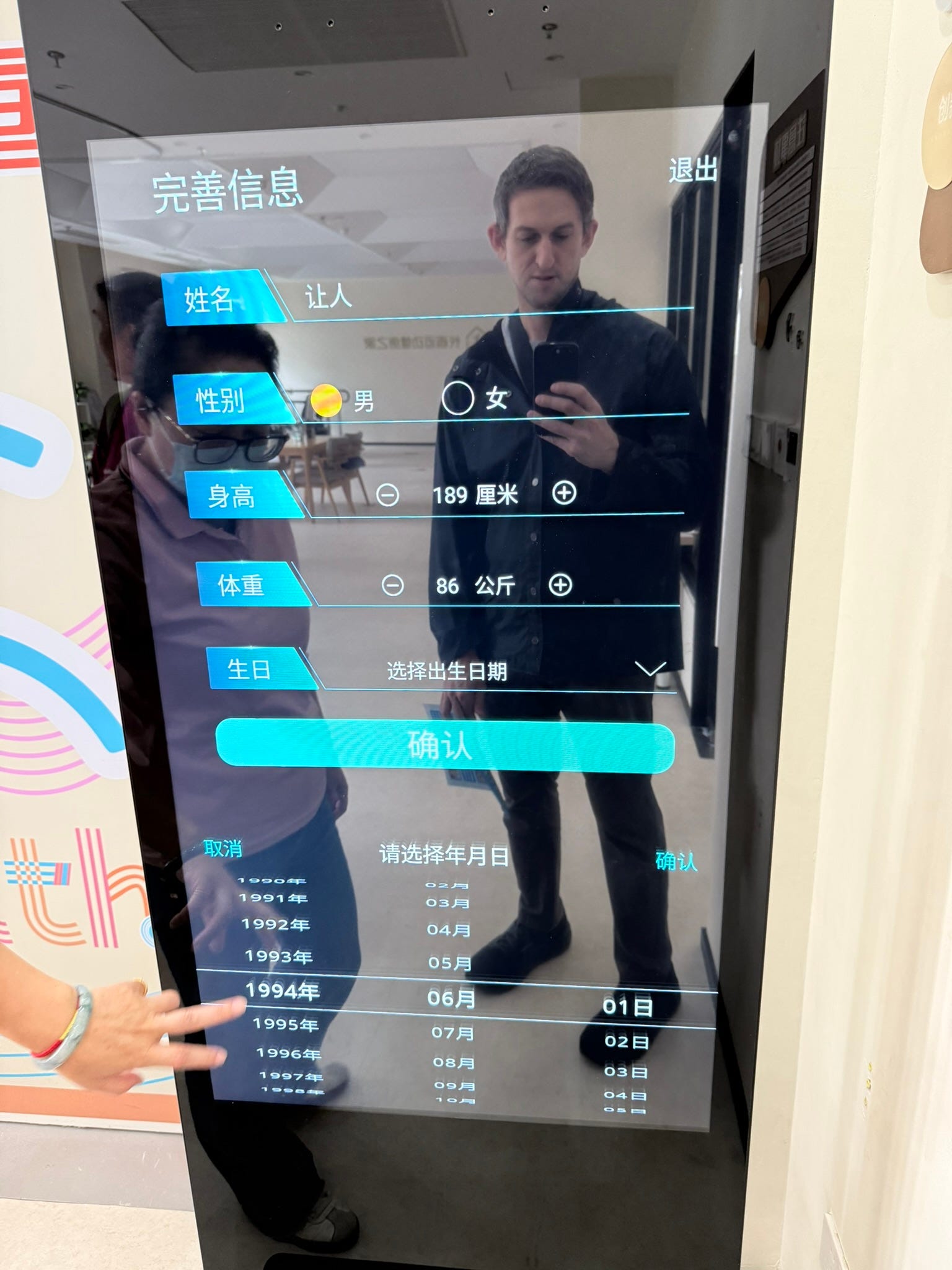
There are services offered by a company called Guorong Leyang —a joint venture of Shanghai’s Fosun Pharmaceutical and Sinopharm, the state-owned pharmaceutical giant, that is providing many of the services on offer. For a few hundred yuan an hour, you can hire a young assistant to accompany your grandmother or grandfather to the hospital to help her navigate her treatment. It’s part of the growing “silver economy” in China—turning the country’s sharply ageing population into yet another area of economic growth. The community center is a showroom for digital products and services of the company. One of them is an automated health detection screen, which primarily focuses on using traditional Chinese medicine diagnostics. It scans my tongue, which is seen in Chinese medicine as a window into the body’s overall health, for a report, and then delivers it to my phone via a QR code. I have too much moisture in my body, according to the report. I need to eat more mushrooms, and avoid keeping my windows open at night. I visit an actual Chinese medicine practicioner to try aijiu and baguan a few days later, and he tells me something similar. So I guess the screen wasn’t so far off, at least as far as translating the principles of Chinese medicine zhongyi into a digital form.
Despite all of the technological progress and Party-led aspirations for technological self sufficiency and even supremacy, there is still the inescapable anxiety and pessimism pervading conversations with people. Innovations in clean energy, robotics, and electric vehicles have improved life in many ways, and certainly aided China’s transition to a cleaner development model. But everyday workers and citizens have not seen much improvement in their own fortunes during the last few years. The property glut continues to drag on the overall economy, as Chinese urban citizens had relied on property assets as a major form of investment during the boom years, lacking other options for investment either in China or overseas.
In a post last summer I wrote about “neijuan”, 内卷 the term that has broad meanings but has come to be a shorthand for the over-competition and overwork that characterizes contemporary life in China. Commonly translated as “overcompetition” when describing the economic situation, the term also has spiritual and cultural connotations, a general “turning inward.” While the China of the early 2000s saw a booming interest in the world, Xi’s China is unmistakably turning more towards its own traditions and itself. A friend working in Shanghai told me some of her younger post 90s generation cousins (roughly equivalent to Gen Z in the U.S.) have little interest in going abroad or in travelling, which was much different from her experience just 10 years before.
Turning inward can also be felt in the spaces urban residents seek out after work. I visited an onsen or a 汤泉 tangquan in the Sihui area of Beijing just East of the CBD— a bathhouse where people spend hours on weekends or after work. China has long had a culture of public bathing and onsens, particularly in the colder North. But in recent years, these facilities have become less about bathing and more about eating, conspicuous lounging, and the influencer or 网红 wanghong economy. For owners of the bathhouses, there is not much use in spending money on designing the bathing area, where phones are not allowed, and therefore not promoted on xiaohongshu—China’s version of Instagram that has quickly come to dominate social and urban life. After bathing, you retire to the upstairs eating areas, offering a cornucopia of tropical fruits, hairy crabs, ice cream, popcorn, and other delicacies.
The design here is exuberant and aimed at influencers, the more to go viral on social media. The influencer economy has transformed how people use urban space. On the bund in Shanghai, I watched a rural migrant breakdancing by himself, livestreaming away probably on Kuaishou or Douyin—perhaps promoting a product or just communicating with his followers on social media. During a thirty-minute subway ride in Shanghai I sat next to a young man in a black jacket as he moved his thumbs furiously, playing a game on his cellphone, not once looking up from his unbroken concentration at any of the other passengers around him.


While these forms of digital anomie are not unique to China, they do seem to be particularly evident amidst the hypercompetitive and stressful rhythms of everyday life in urban China. While American discourse on China is dominated by fear of China’s growing technological and military rivalry, the reality of daily life in China is a bit less glamorous and more mundane. Technological convenience is indeed a part of life in China, ranging from ubiquitous mobile payment systems to robots and electric vehicles. But there is also a sense that China may be following a path of “Japanification,” a society that turns inward even as it achieves remarkable technological progress and advancements in living quality and convenience. More than anything, this trip was a reminder that despite the tendency to view China through lens of exceptionalism or hyperbole, the problems facing China’s people are in many ways shared with those in the U.S. and elsewhere. The dominance of tech giants over urban life, a speculative race towards artificial intelligence and a shrinking pool of good paying entry-level jobs for college graduates, and a turning inward—can be felt in many places. China will surely chart its own course as it deals with these problems, but its always good to do a reality check on the hyperbolic and narrow-minded focus on tech rivalry that pervades U.S. coverage of China these days.
Niuma 牛吗 literally means cow-horse, a neologism describing overworked office and salarymen (and women).
Enjoyed this (though I admit to wanting an AI capybara for myself)
everyday workers and citizens have not seen much improvement in their own fortunes during the last few years?
everyday Chinese workers and citizens have seen considerable improvement in their wages during the last few years, thanks to Beijing's insistence on allocating a fixed 58% of GDP to wages. Real estate is not looked on as an investment there, unlike in America, either.